What Do I Teach for Reading in 3rd Grade
Molly Woodworth was a child who seemed to do well at everything: proficient grades, in the gifted and talented program. Simply she couldn't read very well.
"There was no rhyme or reason to reading for me," she said. "When a teacher would dictate a give-and-take and say, 'Tell me how you think y'all can spell it,' I sabbatum there with my mouth open while other kids gave spellings, and I thought, 'How do they even know where to brainstorm?' I was totally lost."
Woodworth went to public schoolhouse in Owosso, Michigan, in the 1990s. She says sounds and messages merely didn't make sense to her, and she doesn't remember anyone teaching her how to read. Then she came up with her own strategies to get through text.
Strategy ane: Memorize equally many words as possible. "Words were like pictures to me," she said. "I had a really expert retentivity."
Strategy two: Guess the words based on context. If she came across a word she didn't have in her visual memory depository financial institution, she'd look at the first letter and come up up with a word that seemed to make sense. Reading was kind of similar a game of 20 Questions: What discussion could this be?
Strategy 3: If all else failed, she'd skip the words she didn't know.
Most of the fourth dimension, she could get the gist of what she was reading. But getting through text took forever. "I hated reading because it was taxing," she said. "I'd get through a chapter and my brain hurt by the end of it. I wasn't excited to learn."
No ane knew how much she struggled, not fifty-fifty her parents. Her reading strategies were her "dirty little secrets."

Woodworth, who now works in accounting,one says she's notwithstanding not a very good reader and tears upwards when she talks about it. Reading "influences every aspect of your life," she said. She's determined to make sure her ain kids become off to a amend start than she did.
That's why she was then alarmed to see how her oldest child, Claire, was existence taught to read in school.
A couple of years ago, Woodworth was volunteering in Claire's kindergarten classroom. The grade was reading a volume together and the instructor was telling the children to practice the strategies that good readers use.
The instructor said, "If you don't know the word, just expect at this picture upwards here," Woodworth recalled. "At that place was a fox and a acquit in the movie. And the word was bear, and she said, 'Look at the first letter of the alphabet. It's a "b." Is it flim-flam or bear?'"
Woodworth was stunned. "I idea, 'Oh my God, those are my strategies.' Those are the things I taught myself to look like a good reader, non the things that adept readers practise," she said. "These kids were being taught my dirty little secrets."
She went to the teacher and expressed her concerns. The instructor told her she was teaching reading the way the curriculum told her to.
Woodworth had stumbled on to American education's own little hush-hush nigh reading: Elementary schools across the country are teaching children to exist poor readers — and educators may not fifty-fifty know it.
For decades, reading instruction in American schools has been rooted in a flawed theory virtually how reading works, a theory that was debunked decades ago by cerebral scientists, all the same remains deeply embedded in educational activity practices and curriculum materials. As a upshot, the strategies that struggling readers use to go by — memorizing words, using context to guess words, skipping words they don't know — are the strategies that many beginning readers are taught in schoolhouse. This makes it harder for many kids to learn how to read, and children who don't get off to a practiced start in reading find it difficult to ever chief the procedure.two
A shocking number of kids in the United States tin't read very well. A tertiary of all 4th-graders tin can't read at a basic level, and virtually students are even so not proficient readers by the time they finish loftier school.
Percentage of U.S. fourth-graders below basic level in reading
When kids struggle to acquire how to read, it can lead to a downward spiral in which behavior, vocabulary, knowledge and other cognitive skills are eventually affected by deadening reading development.3 A asymmetric number of poor readers become high schoolhouse dropouts and end upwardly in the criminal justice system.four
The fact that a disproven theory about how reading works is nonetheless driving the way many children are taught to read is part of the problem. School districts spend hundreds of millions of taxpayer dollars on curriculum materials that include this theory. Teachers are taught the theory in their instructor preparation programs and on the job. As long as this disproven theory remains part of American education, many kids will probable struggle to learn how to read.
Percentage of U.S. twelfth-graders practiced in reading
The origins
The theory is known as "three cueing." The name comes from the notion that readers employ iii dissimilar kinds of information — or "cues" — to identify words as they are reading.
The theory was first proposed in 1967, when an teaching professor named Ken Goodman presented a paper at the annual meeting of the American Educational Research Association in New York City.
In the paper,five Goodman rejected the thought that reading is a precise process that involves verbal or detailed perception of messages or words. Instead, he argued that as people read, they make predictions about the words on the folio using these three cues:
-
graphic cues (what do the messages tell yous about what the word might be?)
-
syntactic cues (what kind of word could it exist, for example, a substantive or a verb?)
-
semantic cues (what word would make sense here, based on the context?)
Goodman ended that:
Skill in reading involves not greater precision, just more than accurate first guesses based on improve sampling techniques, greater control over language structure, broadened experiences and increased conceptual development. Equally the child develops reading skill and speed, he uses increasingly fewer graphic cues.
Goodman'southward proposal became the theoretical basis for a new approach to teaching reading that would shortly take hold in American schools.
Previously, the question of how to teach reading had focused on ane of two basic ideas.
One idea is that reading is a visual retention process. The didactics method associated with this idea is known as "whole word." The whole discussion approach was perchance best embodied in the "Dick and Jane" books that kickoff appeared in the 1930s. The books rely on give-and-take repetition, and pictures to support the meaning of the text. The idea is that if you see words enough, yous eventually store them in your retention as visual images.

The other idea is that reading requires knowledge of the relationships between sounds and letters. Children larn to read by sounding out words. This arroyo is known every bit phonics. Information technology goes manner back, popularized in the 1800s with the McGuffey readers.
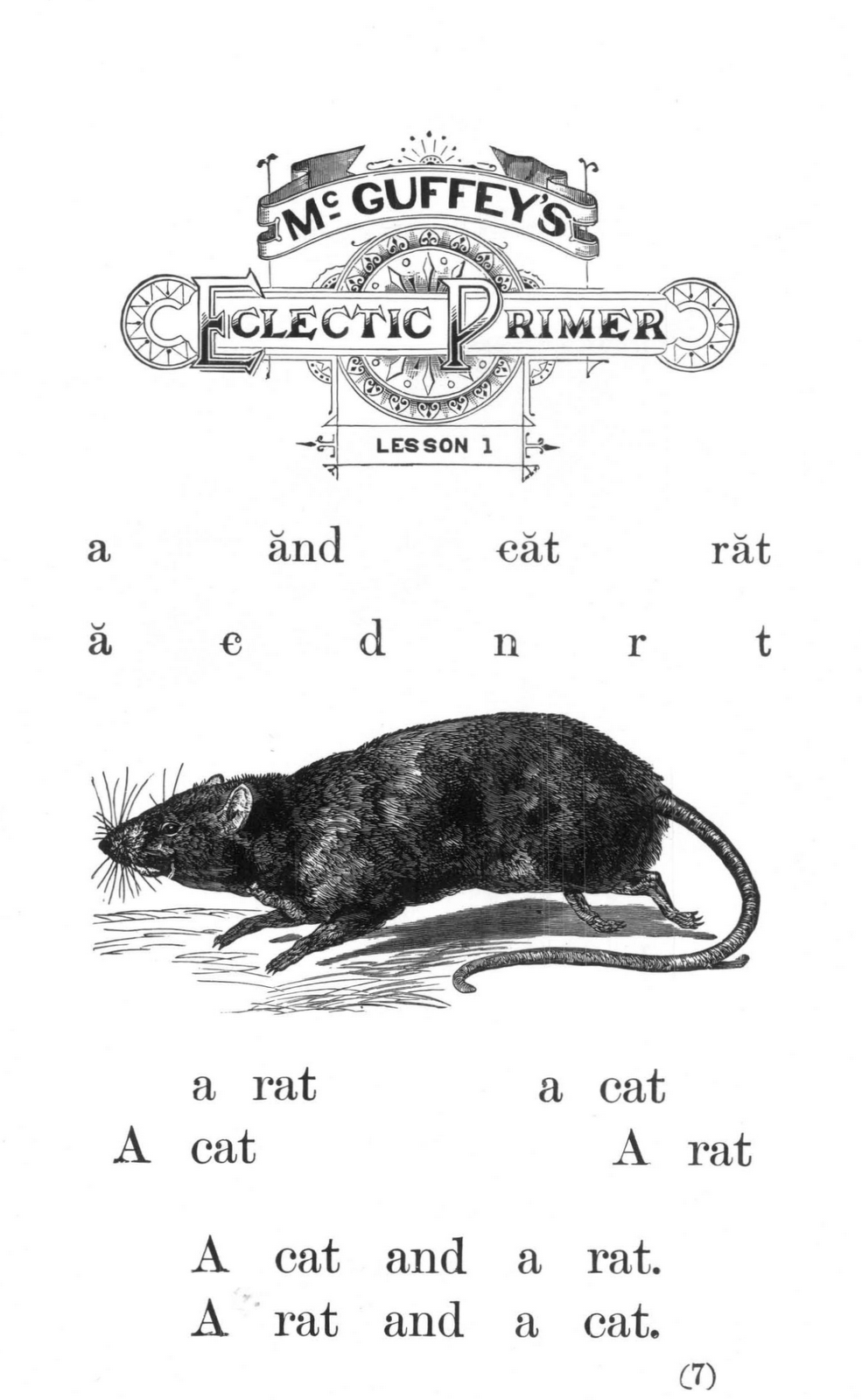
These two ideas — whole word and phonics — had been taking turns equally the favored manner to teach reading until Goodman came along with what came to be known among educators as the "three-cueing system."
In the cueing theory of how reading works, when a child comes to a word she doesn't know, the teacher encourages her to think of a word that makes sense and asks: Does information technology look correct? Does it sound correct? If a word checks out on the ground of those questions, the child is getting it. She's on the path to skilled reading.
Teachers may not know the term "three cueing," but they're probably familiar with "MSV." M stands for using meaning to effigy out what a word is, Southward for using sentence structure and V for using visual information (i.e., the letters in the words). MSV is a cueing idea that can exist traced dorsum to the belatedly Marie Clay, a developmental psychologist from New Zealand who first laid out her theories about reading in a dissertation in the 1960s.half dozen
Dirt adult her cueing theory independently of Goodman, but they met several times and had like ideas well-nigh the reading process. Their theories were based on observational research. They would listen to children read, note the kinds of errors they made, and use that information to identify a child's reading difficulties. For example, a kid who says "horse" when the word was "house" is probably relying as well much on visual, or graphic, cues. A instructor in this example would encourage the child to pay more attention to what word would brand sense in the judgement.
Goodman and Dirt believed that messages were the least reliable of the three cues, and that as people became better readers, they no longer needed to pay attention to all the letters in words. "In efficient word perception the reader relies mostly on the judgement and its meaning and some selected features of the forms of words," Dirt wrote.7 For Goodman, accurate word recognition was non necessarily the goal of reading. The goal was to comprehend text.eight If the sentences were making sense, the reader must be getting the words correct, or correct enough.
These ideas soon became the foundation for how reading was taught in many schools. Goodman'south three-cueing idea formed the theoretical basis of an approach known every bit "whole language" that by the belatedly 1980s had taken hold throughout America.nine Clay built her cueing ideas into a reading intervention program for struggling first-graders called Reading Recovery. It was implemented beyond New Zealand in the 1980s and went on to become i of the world's nearly widely used reading intervention programs.ten
But while cueing was taking hold in schools, scientists were busy studying the cerebral processes involved in reading words. And they came to different conclusions about how people read.xi

Scientists have on three cueing
It was the early 1970s, and Keith Stanovich was working on his doctorate in psychology at the University of Michigan. He thought the reading field was ready for an infusion of knowledge from the "cognitive revolution" that was underway in psychology. Stanovich had a background in experimental science and an interest in learning and cognition due in part to the influence of his wife, Paula, who was a special educational activity teacher.
Stanovich wanted to sympathize how people read words.12 He knew nearly Goodman'due south piece of work and thought he was probably correct that as people become amend readers, they relied more than on their knowledge of vocabulary and language construction to read words and didn't need to pay as much attending to the messages.
So, in 1975, Stanovich and a beau graduate pupil fix out to test the idea in their lab. They recruited readers of various ages and abilities and gave them a serial of word-reading tasks. Their hypothesis was that skilled readers rely more on contextual cues to recognize words than poor readers, who probably weren't as proficient at using context.
They couldn't have been more wrong.
"To our surprise, all of our research results pointed in the contrary management," Stanovich wrote. "Information technology was the poorer readers, not the more than skilled readers, who were more than reliant on context to facilitate give-and-take recognition."thirteen
The skilled readers could instantly recognize words without relying on context. Other researchers have confirmed these findings with like experiments. It turns out that the power to read words in isolation quickly and accurately is the hallmark of being a skilled reader. This is now one of the well-nigh consequent and well-replicated findings in all of reading research.14
Other studies revealed further problems with the cueing theory:15
-
Skilled readers don't scan words and sample from the graphic cues in an incidental way; instead, they very speedily recognize a discussion as a sequence of messages. That's how good readers instantly know the divergence between "house" and "equus caballus," for case.
-
Experiments that force people to use context to predict words show that even skilled readers can correctly judge simply a fraction of the words; this is ane reason people who rely on context to place words are poor readers.
-
Weak discussion recognition skills are the most mutual and debilitating source of reading issues.16
The results of these studies are not controversial or contested amongst scientists who study reading. The findings have been incorporated into every major scientific model of how reading works.
Simply cueing is even so live and well in schools.
Picture Power!
Information technology's non difficult to notice examples of the cueing organisation. A quick search on Google, Pinterest or Teachers Pay Teachers turns upward enough of lesson plans, education guides and classroom posters. One popular poster has cute cartoon characters to remind children they have lots of strategies to employ when they're stuck on a give-and-take, including looking at the moving picture (Eagle Eye), getting their lips ready to endeavour the first sound (Lips the Fish), or just skipping the discussion altogether (Skippy Frog).

In that location are videos online where you tin can come across cueing in action. In one video posted on The Teaching Channel,17 a kindergarten teacher in Oakland, California, instructs her students to use "film ability" to identify the words on the page. The goal of the lesson, co-ordinate to the instructor, is for the students to "utilize the picture and a offset sound to determine an unknown word in their book."
The class reads a book together called "In the Garden." On each page, in that location'southward a picture of something y'all might find in a garden. It's what'due south known equally a predictable book; the sentences are all the same except for the concluding give-and-take.

The children have been taught to memorize the words "look," "at," and "the." The claiming is getting the terminal word in the sentence. The lesson programme tells the teacher to cover up the give-and-take with a glutinous note.
In the video, the wiggly kindergarteners sitting cross-legged on the floor come to a page with a picture of a butterfly. The teacher tells the kids that she'south guessing the word is going to be butterfly. She uncovers the word to bank check on the accuracy of her guess.
"Look at that," she tells the children, pointing to the first alphabetic character of the word. "It starts with the /b/ /b/ /b/." The class reads the sentence together as the teacher points to the words. "Look at the butterfly!" they yell out excitedly.
This lesson comes from "Units of Written report for Teaching Reading," more usually known as "reader'due south workshop."18 According to the lesson programme, this lesson teaches children to "know and apply grade-level phonics and give-and-take analysis skills in decoding words."19
But the children were not taught to decode words in this lesson. They were taught to gauge words using pictures and patterns — hallmarks of the three-cueing organisation.
The author of Units of Study for Educational activity Reading, Lucy Calkins, ofttimes refers to cueing in her published work.20 She uses the term MSV — the meaning, structure and visual thought that originally came from Dirt in New Zealand.
And so there is Fountas and Pinnell Literacy, started past Irene Fountas and Gay Su Pinnell, teachers who learned the MSV concept from Clay in the 1980s.21
Fountas and Pinnell take written several books about teaching reading, including a best-seller about a widely used instructional approach called "Guided Reading." They also created a reading assessment arrangement that uses what are called "leveled books."22 Children start with anticipated books like "In the Garden" and move up levels every bit they're able to "read" the words. But many of the words in those books — butterfly, caterpillar — are words that starting time readers haven't been taught to decode even so. Ane purpose of the books is to teach children that when they go to a give-and-take they don't know, they can use context to figure it out.
When put into practise in the classroom, these approaches can cause problems for children when they are learning to read.
'That is non reading'
Margaret Goldberg, a teacher and literacy coach in the Oakland Unified School District, remembers a moment when she realized what a trouble the 3-cueing approach was. She was with a first-grader named Rodney when he came to a page with a picture show of a girl licking an ice cream cone and a domestic dog licking a bone.
The text said: "My little dog likes to consume with me."
But Rodney said: "My dog likes to lick his bone."

Rodney breezed correct through it, unaware that he hadn't read the sentence on the folio.
Goldberg realized lots of her students couldn't actually read the words in their books; instead, they were memorizing sentence patterns and using the pictures to judge. 1 little boy exclaimed, "I tin can read this book with my eyes shut!"
"Oh no," Goldberg thought. "That is not reading."
Goldberg had been hired by the Oakland schools in 2015 to aid struggling readers by teaching a Fountas and Pinnell plan called "Leveled Literacy Intervention" that uses leveled books and the cueing approach.23
Around the same time, Goldberg was trained in a program that uses a unlike strategy for didactics children how to read words. The program is chosen "Systematic Pedagogy in Phonological Sensation, Phonics, and Sight Words," or SIPPS.24 It's a phonics plan that teaches children how to audio out words and uses what are known as "decodable books." Virtually words in the books have spelling patterns that kids accept been taught in their phonics lessons.
Goldberg decided to teach some of her students using the phonics program and some of her students using three cueing. And she began to detect differences betwixt the two groups of kids. "Not just in their abilities to read," she said, "but in the way they approached their reading."
Goldberg and a colleague recorded first-graders talking well-nigh what makes them good readers.
One video shows Mia, on the left, who was in the phonics program. Mia says she's a good reader considering she looks at the words and sounds them out. JaBrea, on the right, was taught the cueing system. JaBrea says: "I look at the pictures and I read it."
Courtesy of Margaret Goldberg, Oakland Unified School District
It was clear to Goldberg after merely a few months of pedagogy both approaches that the students learning phonics were doing better. "One of the things that I even so struggle with is a lot of guilt," she said.
She thinks the students who learned three cueing were actually harmed by the approach. "I did lasting damage to these kids. It was so hard to ever get them to stop looking at a motion-picture show to guess what a word would be. It was so hard to e'er get them to wearisome down and sound a word out because they had had this experience of knowing that you lot predict what yous read earlier you read it."
Goldberg soon discovered the decades of scientific prove against cueing.25 She was shocked. She had never come across any of this science in her instructor preparation or on the job.
And she started to wonder why not.
Balanced Literacy
People have been arguing for centuries about how children should be taught to read. The fight has mostly focused on whether to teach phonics.
The whole linguistic communication movement of the tardily 20th century was perhaps the zenith of the anti-phonics statement.26 Phonics instruction was seen as tedious, fourth dimension-consuming and ultimately unnecessary. Why? Considering — according to the three-cueing theory — readers can utilize other, more reliable cues to effigy out what the words say.27
Marilyn Adams came across this belief in the early 1990s. She'southward a cerebral and developmental psychologist who had just written a volume summarizing the research on how children larn to read.28 One big takeaway from the volume is that becoming a skilled reader of English requires cognition of sound-spelling correspondences.29 Another big takeaway is that many kids were not being taught this in schoolhouse.
Soon later the volume was published, Adams was describing her findings to a group of teachers and land education officials in Sacramento, California. She was sensing discomfort and confusion in the room. "And I just stopped and said, 'What is information technology that I'm missing?'" she recalled. "'What is information technology that we need to talk about? Assistance me.'"
A woman raised her paw and asked: "What does this have to do with the three-cueing system?" Marilyn didn't know what the three-cueing system was. "I recollect I blew all of their fuses that I did non [know what it was] since this was then fundamental to existence an uncomplicated reading instructor," she said. "How could I nowadays myself to them as an expert on reading and not know most this?"
The teachers drew her a Venn diagram of the three-cueing system. Information technology looked something similar this:

Adams idea this diagram made perfect sense. The research conspicuously shows that readers use all of these cues to understand what they're reading.
But Adams presently figured out the disconnect. Teachers understood these cues non just as the manner readers construct significant from text, but equally the way readers actually identify the words on the page. And they idea that teaching kids to decode or sound out words was non necessary.
"The most important thing was for the children to understand and savor the text," Adams said. "And from that understanding and joy of reading, the words on the page would merely pop out at them."
She would explain to teachers at every opportunity that explicitly didactics children almost the relationships betwixt sounds and messages is essential to ensure all kids get off to a good start in reading. But she got tons of pushback from teachers. "They didn't want to teach phonics!" she recalled in frustration.
In 1998, Adams wrote a book chapter virtually how the iii-cueing organisation conflicts with what researchers have figured out about reading. She hoped it would assist put three cueing to remainder.30
By this time, the scientific research on reading was gaining traction. In 2000, a national panel convened by Congress to review the evidence on how to teach reading came out with a report.31 It identified several essential components of reading instruction, including vocabulary, comprehension and phonics. The bear witness that phonics instruction enhances children's success in learning how to read was articulate and compelling. National reports on reading a few years afterwards in the Uk and Australia came to the same conclusion.32
Somewhen, many whole linguistic communication supporters accustomed the weight of the scientific evidence about the importance of phonics instruction. They started adding phonics to their books and materials and renamed their approach "counterbalanced literacy."
But they didn't become rid of the three-cueing organization.
Balanced literacy proponents will tell you their approach is a mix of phonics didactics with plenty of time for kids to read and savour books. But wait carefully at the materials and you'll see that's not actually what balanced literacy is mixing. Instead, information technology'due south mixing a bunch of different ideas about how kids learn to read. Information technology'south a niggling chip of whole word instruction with long lists of words for kids to memorize. Information technology's a trivial bit of phonics. And fundamentally, information technology'south the idea that children should be taught to read using the 3-cueing system.
And it turns out cueing may actually foreclose kids from focusing on words in the manner they demand to become skilled readers.
Mapping the words
To understand why cueing can go in the manner of children'south reading evolution, it's essential to sympathise how our brains procedure the words we run into.
Reading scientists take known for decades that the authentication of being a skilled reader is the power to instantly and accurately recognize words.33 If you're a skilled reader, your encephalon has gotten so good at reading words that y'all process the discussion "chair" faster than you process a picture of a chair.34 Y'all know tens of thousands of words instantly, on sight. How did yous acquire to do that?
It happens through a process called "orthographic mapping."35 This occurs when y'all pay attention to the details of a written word and link the give-and-take'due south pronunciation and pregnant with its sequence of messages.36 A kid knows the meaning and pronunciation of "pony." The give-and-take gets mapped to his retentiveness when he links the sounds /p/ /o/ /n/ /y/ to the written give-and-take "pony."
That requires an awareness of the speech sounds in words and an understanding of how those sounds are represented past letters.37 In other words, you demand phonics skills.
Here'south what happens when a reader who has skillful phonics skills comes to a word she doesn't recognize in print. She stops at the give-and-take and sounds information technology out. If it's a word she knows the meaning of, she has now linked the spelling of the give-and-take with its pronunciation. If she doesn't know the meaning of the discussion, she tin can use context to try to figure it out.
By about second course, a typically developing reader needs simply a few exposures to a word through agreement both the pronunciation and the spelling for that word to be stored in her memory.38 She doesn't know that discussion because she memorized information technology as a visual prototype. She knows that word because at some signal she successfully sounded it out.
The more words she stores in her retention this style, the more she can focus on the significant of what she's reading; she'll eventually be using less brain power to identify words and will be able to devote more brain power to comprehending what she's reading.39
Merely when children don't have proficient phonics skills, the procedure is different.
"They sample from the letters because they're not practiced at sounding them out," said David Kilpatrick, a psychology professor at SUNY Cortland and the writer of a book about preventing reading difficulties.forty "And they use context."
In other words, when people don't have good phonics skills, they use the cueing system.
"The 3-cueing system is the manner poor readers read," said Kilpatrick.
And if teachers use the cueing system to teach reading, Kilpatrick says they're not only instruction children the habits of poor readers, they are actually impeding the orthographic mapping process.41
"The minute you ask them merely to pay attention to the showtime letter or look at the picture, look at the context, you're cartoon their attention away from the very affair that they demand to interact with in order for them to read the word [and] remember the word," Kilpatrick said. In this way, he said, three cueing can really forestall the critical learning that's necessary for a kid to become a skilled reader.
In many balanced literacy classrooms, children are taught phonics and the cueing organization. Some kids who are taught both approaches realize pretty quickly that sounding out a word is the most efficient and reliable way to know what it is. Those kids tend to take an easier time agreement the ways that sounds and letters relate. They'll drop the cueing strategies and begin building that big bank of instantly known words that is so necessary for skilled reading.
Simply some children will skip the sounding out if they're taught they accept other options. Phonics is challenging for many kids. The cueing strategies seem quicker and easier at first. And by using context and memorizing a agglomeration of words, many children can await like good readers — until they go to nigh third grade, when their books begin to have more than words, longer words, and fewer pictures. Then they're stuck. They haven't adult their sounding-out skills. Their bank of known words is limited. Reading is slow and laborious and they don't similar it, then they don't do it if they don't have to. While their peers who mastered decoding early are reading and teaching themselves new words every solar day, the kids who clung to the cueing approach are falling further and further behind.42
These poor reading habits, once ingrained at a young age, can follow kids into high school. Some kids who were taught the cueing arroyo never get good readers. Non considering they're incapable of learning to read well but because they were taught the strategies of struggling readers.

'So what if they utilise the motion picture?'
Once Margaret Goldberg discovered the cognitive science prove confronting cueing, she wanted her colleagues in the Oakland schoolhouse district to know nearly it too.
Over the past two years, Goldberg and a fellow literacy charabanc named Lani Mednick accept been leading a grant-funded pilot projection to improve reading achievement in the Oakland schools.43
They have their piece of work cut out for them. Nearly one-half the district'due south third-graders are below grade level in reading. Goldberg and Mednick want to raise questions about how kids in Oakland are being taught to read.
They meet every couple weeks with literacy coaches from the ten elementary schools in the pilot program. They read and discuss articles about the scientific research on reading. At a coming together in March, the coaches watched the video of the "picture power" lesson.
"This instructor meant well," Mednick said to the coaches after they watched the lesson. "Information technology seemed like she believed this lesson would ensure her students would be on the road toward reading."
Mednick wanted the coaches to consider the behavior nearly reading that would lead to the cosmos of a lesson like "flick ability." The Oakland schools purchased the Units of Written report for Teaching Reading series, which includes the "motion picture power" lesson, as office of a balanced literacy initiative the district began most 10 years ago. The district also bought the Fountas and Pinnell cess system.
The coaches saw right away that "movie power" was designed to teach kids the cueing organization. Just they said many teachers don't see any problem with cueing. After all, i of the cues is to look at the letters in the word. What'southward wrong with teaching kids lots of different strategies to effigy out unknown words?44
"I call back before we started looking at the science and everything, I thought to myself, 'Reading is so hard for kids, so what if they use the picture?'" said Soraya Sajous-Brooks, the early literacy coach at Prescott Elementary School in West Oakland. "Like, utilise everything yous've got."
But she's come to understand that cueing sends the message to kids that they don't need to audio out words. Her students would go phonics instruction in one part of the day. Then they'd go reader'due south workshop and be taught that when they come to a discussion they don't know, they have lots of strategies. They can sound it out. They tin also check the starting time letter, wait at the picture, think of a discussion that makes sense.
Teaching cueing and phonics doesn't piece of work, Sajous-Brooks said. "One negates the other."
Goldberg and Mednick want to show the district there's a better style to teach reading. Schools in the airplane pilot project used grant money to buy new materials that steer clear of the iii-cueing thought. Two lease school networks in Oakland are working on similar projects to move their schools away from cueing.
To meet what it looks like, I visited a first-class classroom at a lease schoolhouse in Oakland called Achieve Academy.45
1 function of the 24-hour interval was explicit phonics teaching.46 The students were divided into small groups based on their skill level. They met with their teacher, Andrea Ruiz, at a kidney-shaped table in a corner of the classroom. The lowest-level grouping worked on identifying the speech sounds in words like "peel" and "skip." The highest-level group learned how verbs similar "spy" and "cry" are spelled as "spied' and 'cried" in the past tense.

There were as well vocabulary lessons.47 The entire form gathered on a carpeting at the front of the classroom to talk nearly a book Ms. Ruiz read out loud to them. One of the words in the book was "prey."
"What animals are a chameleon's prey?" Ms. Ruiz asked the children. "Or we tin also ask, what animals do chameleons hunt for food?"
The kids turned and talked to each other. "A chameleon's prey are bugs and insects and other chameleons and mice and birds," a petty boy explained to his classmate. "That's it."
Other vocabulary words these kickoff-graders had learned were posted on cards around the classroom. They included: wander, persevere, squint and scrumptious. The kids weren't expected to read those words yet. The idea is to build their oral vocabulary so that when they can read those words, they know what the words mean.
This comes straight from the scientific research, which shows that reading comprehension is the product of ii things.48 First, a child needs to exist able to sound out a word. 2d, the kid needs to know the meaning of the word she just sounded out. So, in a commencement-grade classroom that'southward following the research, you will encounter explicit phonics pedagogy and too lessons that build oral vocabulary and background knowledge. And you will run into kids practicing what they've been taught.
After their vocabulary lesson, the kids did "buddy reading." They retreated to various spots around the classroom to read books to each other. I found Belinda sitting on an adult chair at the dorsum of the classroom, her little legs swinging. Across from her was her buddy Steven, decked out in a yellow and bluish plaid shirt tucked neatly into his jeans. He held the book and pointed to the words while Belinda read.
"Ellen /m/," Belinda paused, sounding out the word "meets." She was reading a decodable book about some kids who visit a subcontract. Almost all of the words in the volume contain spelling patterns she'd been taught in her phonics lessons.
"I am a farm here," Belinda read.
Steven did a double-take. "A farmer here," he said gently. Steven's job as Belinda'southward reading buddy was to help her if she missed a word or got stuck. Merely that didn't happen much considering Belinda had been taught how to read the words. She didn't need any aid from the pictures, either. She barely glanced at them as she read.

To be clear, there'southward null incorrect with pictures. They're not bad to await at and talk about, and they can help a kid comprehend the meaning of a story. Context — including a motion-picture show if at that place is i — helps us understand what nosotros're reading all the fourth dimension. But if a child is existence taught to use context to place words, she's being taught to read like a poor reader.
Many educators don't know this because the cognitive science research has not made its way into many schools and schools of pedagogy.49
Ruiz didn't know nearly this inquiry until the Oakland pilot projection. "I didn't really know anything nearly how kids acquire to read when I started pedagogy," she said. It was a relief when she came to Oakland and the curriculum spelled out that kids use meaning, construction and visual cues to figure out words. "Because I came from not having anything, I was like, 'Oh, there's a fashion we should teach this,'" she said.
I heard this from other educators. Cueing was appealing because they didn't know what else to do.
"When I got into the classroom and someone told me to use this practice, I didn't question it," said Stacey Cherny, a former teacher who's now principal of an elementary schoolhouse in Pennsylvania. She says many teachers aren't taught what they need to know about the structure of the English linguistic communication to exist able to teach phonics well. She says phonics can be intimidating; three cueing isn't.
Another reason cueing holds on is that information technology seems to work for some children. But researchers judge there'due south a percentage of kids — mayhap about xl percent — who will learn to read no thing how they're taught.fifty According to Kilpatrick, children who acquire to read with cueing are succeeding in spite of the instruction, not because of information technology.
Goldberg hopes the airplane pilot project in Oakland will convince the district to driblet all instructional materials that include cueing.
When asked about this, the Oakland superintendent'southward office responded with a written statement that there isn't enough testify from the pilot project to make curriculum changes for the unabridged district and that the Oakland schools remain committed to counterbalanced literacy.
Oakland's situation is no different from many other districts across the country that have invested millions of dollars in materials that include cueing.
"It feels like everyone's trusting somebody else to accept done their due diligence," Goldberg said. "Classroom teachers are trusting that the materials they're existence handed will piece of work. The people who purchase the materials are trusting if they were on the market, that they will work. We're all trusting, and it's a organization that is broken."
'My science is different'
If cueing was debunked decades ago by cognitive scientists, why is the thought nonetheless in materials that are being sold to schools?
1 respond to that question is that school districts still buy the materials. Heinemann, the company that publishes the Fountas and Pinnell and Lucy Calkins' products that the Oakland schools apply, earned somewhere in the neighborhood of $500 million in 2018, co-ordinate to earnings reports.51
I wanted to know what the authors of those materials make of the cognitive scientific discipline inquiry. And I wanted to give them a take a chance to explain the ideas backside their piece of work. I wrote to Calkins, Fountas and Pinnell and asked for interviews. They all declined. Heinemann sent a argument that said every product the company sells is informed by all-encompassing research.
I also asked Ken Goodman for an interview. It's been more than than 50 years since he first laid out the three-cueing theory in that 1967 paper. I wanted to know what he thinks of the cognitive science research. Of the major proponents of three cueing I reached out to, he was the only 1 who agreed to an interview.
I visited Goodman at his home in Tucson, Arizona. He'due south 91. He uses a scooter to get effectually, but he'due south still working. He just finished a new edition of i of his books.

When I asked him what he makes of the cognitive science research, he told me he thinks scientists focus too much on word recognition. He even so doesn't believe authentic word recognition is necessary for reading comprehension.
"Word recognition is a preoccupation," he said. "I don't teach word recognition. I teach people to make sense of language. And learning the words is incidental to that."
He brought up the case of a kid who comes to the word "equus caballus" and says "pony" instead. His argument is that a child will still understand the significant of the story because horse and pony are the same concept.
I pressed him on this. First of all, a pony isn't the same thing equally a horse. 2nd, don't you want to make sure that when a child is learning to read, he understands that /p/ /o/ /north/ /y/ says "pony"? And different messages say "equus caballus"?
He dismissed my question.
"The purpose is non to learn words," he said. "The purpose is to brand sense."
Cognitive scientists don't dispute that the purpose of reading is to make sense of the text. But the question is: How can y'all understand what you are reading if you can't accurately read the words? And if quick and authentic word recognition is the hallmark of being a skilled reader, how does a little kid become in that location?
Goodman rejected the idea that you can make a stardom between skilled readers and unskilled readers; he doesn't like the value judgment that implies. He said dyslexia does not exist — despite lots of show that it does.52 And he said the three-cueing theory is based on years of observational enquiry. In his view, iii cueing is perfectly valid, drawn from a different kind of prove than what scientists collect in their labs.
"My scientific discipline is different," Goodman said.
This idea that there are different kinds of evidence that lead to dissimilar conclusions about how reading works is one reason people go on to disagree about how children should be taught to read. It's important for educators to understand that three cueing is based on theory and observational research and that there's decades of scientific show from labs all over the world that converges on a very different thought about skilled reading.
The cognitive science does not provide all the answers about how to teach children to read, just on the question of how skilled readers read words, scientists have amassed a huge torso of show.
Goldberg thinks it'due south time for educators across the country to have a close look at all the materials they utilise to teach reading.
"We should look through the materials and search for testify of cueing," she said. "And if information technology's in that location, don't bear upon information technology. Don't let it get near our kids, don't let it get near our classrooms, our teachers."
At a Loss for Words is ane of three sound documentaries this season from the Educate podcast — stories nearly education, opportunity, and how people learn.


Share and talk over on Facebook
EXECUTIVE EDITOR
Stephen Smith
EDITOR
Catherine Winter
ASSOCIATE PRODUCER
Alex Baumhardt
PRODUCTION Assistance
John Hernandez
WEB EDITORS
Andy Kruse
Dave Mann
Sound MIX
Craig Thorson
Chris Julin
EDITOR-IN-CHIEF
Chris Worthington
Project COORDINATOR
Shelly Langford
THEME MUSIC
Gary Meister
FACT CHECKER
Betsy Towner Levine
Re-create EDITOR
Sherri Hildebrandt
SPECIAL Thanks
Sasha Aslanian
Heena Srivastava
Back up for this program comes from the Spencer Foundation and Lumina Foundation.


Feedback
We're interested in hearing what touch APM Reports programs accept on you lot. Has i of our documentaries or podcasts inverse how you call back about an outcome? Has it led yous to do something, similar start a conversation or endeavour to do something new in your community? Share your impact story.
Resources
- Printable version of this story
- Full documentary transcript
Sign up for email notifications
Enter your address below and nosotros'll let you know when we publish new stories.
Source: https://www.apmreports.org/episode/2019/08/22/whats-wrong-how-schools-teach-reading

Postar um comentário for "What Do I Teach for Reading in 3rd Grade"